Relationship Radar
The people you're closest to at work aren't always the people you need to be closest to.
As engineering managers, we can spend most of our time deep in execution. We spend our day to day unblocking teams, managing delivery and navigating difficult technical decisions. But influence in an organisation doesn't flow through org charts. It flows through relationships. And most of us have never deliberately audited ours.
Mapping Where You Are
One exercise I've found genuinely useful is the Relationship Radar.
The concept is simple. Draw a circle. Place yourself at the centre. Now plot the people you should be working with on the circle - not by title or reporting line, but by proximity. How close is your actual working relationship with each person?
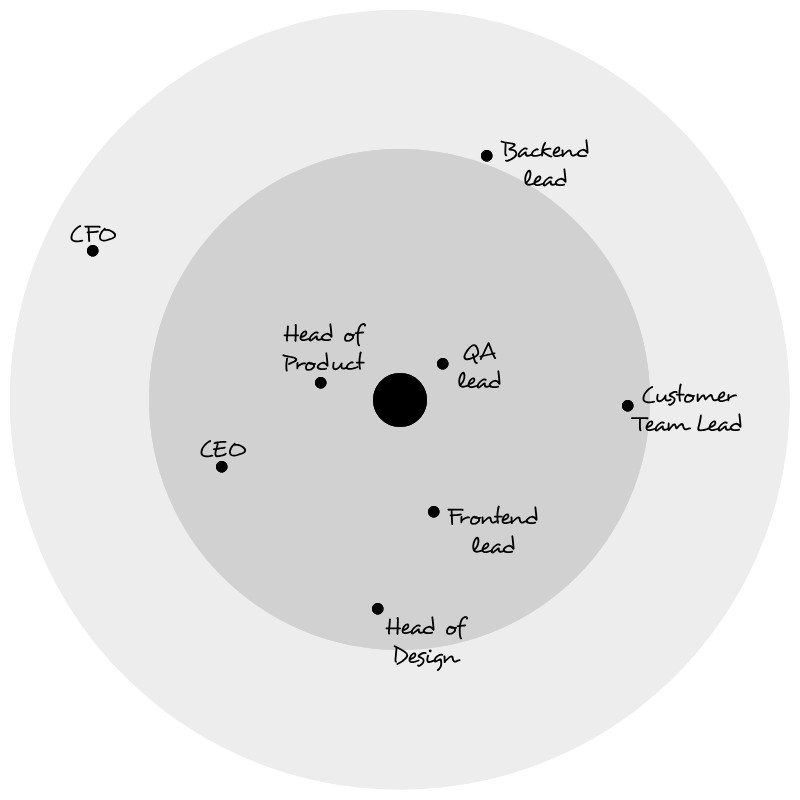
An example of a relationship radar
The exercise only works if you're honest with yourself about your relationships when you complete your circle. For example, the QA lead you sync with daily will be close. The CFO you've met twice sits near the edge.
What you'll likely find is a cluster of familiar faces near the middle — and a ring of people on the outside who probably shouldn't be there.
The Gap Is the Point
The radar's real value isn't the map itself. It's the gap between where people are and where they should be.
Who are the stakeholders whose priorities you don't fully understand? Whose buy-in you'd need if you wanted to push through a meaningful change? Whose opinion shapes decisions before they ever reach you?
Those are the relationships worth investing in - and you should invest in them before you need something from them.
Proximity Is a Choice
Strong engineering leaders don't wait for relationships to form organically. They build them deliberately. Go for a regular coffee, ask a genuine question about someone's priorities and show curiosity about problems outside your immediate domain.
The radar won't tell you what to do. But it will tell you where to start and who you should be booking in a 1-1 with.

By Andi Smith
Related Blog Posts
Remote-First Engineering at Scale
The pandemic in 2020 changed the world of software development forever, with teams forced to work remotely.